Principal Investigator
My research is inspired by the remarkable fact that a simple four-letter code generates the immense diversity we see across the tree of life.
I am passionate about developing high-throughput sequencing and computational approaches to understand the molecular mechanisms that give rise to this diversity, with a focus on investigating innate animal behaviors.
I am currently a Group Leader at EMBL Rome. Prior to this, I was a Harvard Data Science Fellow and MOSAIC NIH K99/R00 Fellow, and I worked with Hopi Hoekstra and Sean Eddy on the genetic basis of monogamy-related behaviors in Peromyscus deer mice. I received my PhD in Bioinformatics and Integrative Genomics from MIT, where I was advised by Aviv Regev.

Our research aims to investigate the evolution of innate social behaviors and discover novel neuropeptides.
To do so, we take advantage of evolutionary patterns of innate animal behaviors, and use comparative genomics approaches combined with techniques from neurogenetics and behavioral neuroscience. We work with non-traditional mammalian model organisms, like closely related Peromyscus deer mouse species that have evolved a variety of innate behaviors despite their high degree of shared genetic similarity.
Monogamy has independently evolved multiple times across the rodent lineage, and co-evolves with a suite of behaviors including biparental care, increased territoriality, and selective aggression. What genes encode these behaviors, and how do they evolve to produce differences across species? To answer this, we use single-cell multiomics to characterize how hypothalamic neurons are evolving across monogamous and promiscuous rodent species, paired with neurogenetic approaches to identify key genetic changes driving this behavioral evolution.
In the Press
Neuropeptides are critical signaling molecules that regulate diverse biological processes, yet some may remain undiscovered due to their small size and low abundance. We develop computational methods to discover novel neuropeptides and generate transgenic rodent models to investigate their function.
Group Leader
Incoming Graduate Student
The full publication list is available at Google Scholar. Asterisks (*) mark equal contributions.
2024
Chen J, Richardson PR, Kirby C, Eddy SR, and HE Hoekstra. Cellular evolution of the hypothalamic preoptic area of behaviorally divergent deer mice. eLife. 2024; e103109.
Kautt A*, Chen J*, Lewarch CL, Hu C, Turner K, Lassance JM, Baier F, Bedford NL, Bendesky A, and HE Hoekstra. Evolution of gene expression across brain regions in behaviorally divergent deer mice and their hybrids. Molecular Ecology. 2024; e17270.
2019
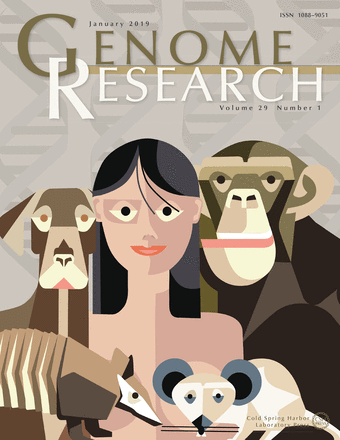
Chen J, Swofford R, Johnson J, Cummings BB, Rogel N, Lindblad-Toh K, Haerty W, di Palma F, and A Regev. A quantitative model for characterizing the evolutionary history of mammalian gene expression. Genome Research. 2019; 29: 53–63.
2016
Chen J, Shishkin A, Zhu X, Kadri S, Hanna J, Regev A, and M Garber. Evolutionary analysis across mammals reveals distinct classes of long noncoding RNAs. Genome Biology. 2016; 17: 19.
We are looking for curious, collaborative people interested in working at the interface of genomics, evolution, and neuroscience. Those with backgrounds in either computational or experimental biology are all welcome. The lab is based at EMBL Rome, in Monterotondo, Italy — about 20 minutes north of Rome.
Prospective graduate students: I accept graduate students through the EMBL International PhD Programme. Interested students are welcome to email jennifer.chen @ embl.it to discuss fit for the lab. Please include your CV and a brief description of your research interests.
Prospective postdocs: Send a brief description of your research interests and how they connect to the lab, along with your CV to jennifer.chen @ embl.it.